· Enes
Redesigning the Essence Tree, ring by ring
The Essence Tree is where a fall turns into progress: the essence a lost run pays is spent there, and the next run goes further for it. It is the biggest system in Marrow March, and over the last few updates it was redesigned from the ground up. This is how, and why.
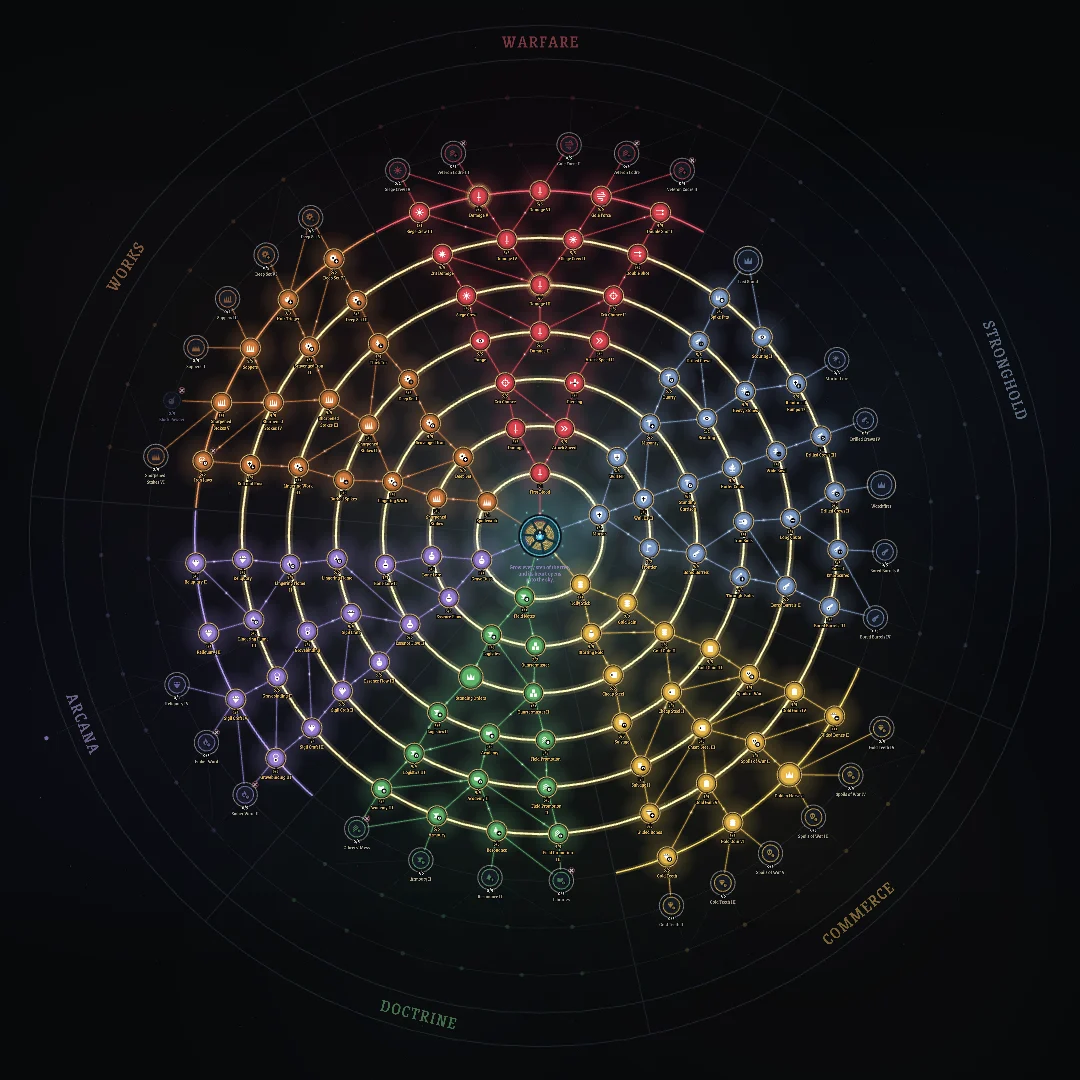
Where it started
In the first builds the tree was six tabs of grey squares, one for each discipline: a hundred and thirty upgrades that read like a settings page. The first redesign made it one window, with the heart of the city in the middle and six petals of coloured glass around it, warfare at the top. Then the long ladders went. No upgrade holds more than five levels now: a long line is a chain of small steps, each its own medallion, one ring further out.
The window still did not read. Its circles were drawn, but the medallions stood between them. A link could skip two rings on its way out. Some petals ran flat, two steps a ring all the way to the rim. And the prices followed old curves, so a single step at the tip of a chain could cost as much as a whole ring.
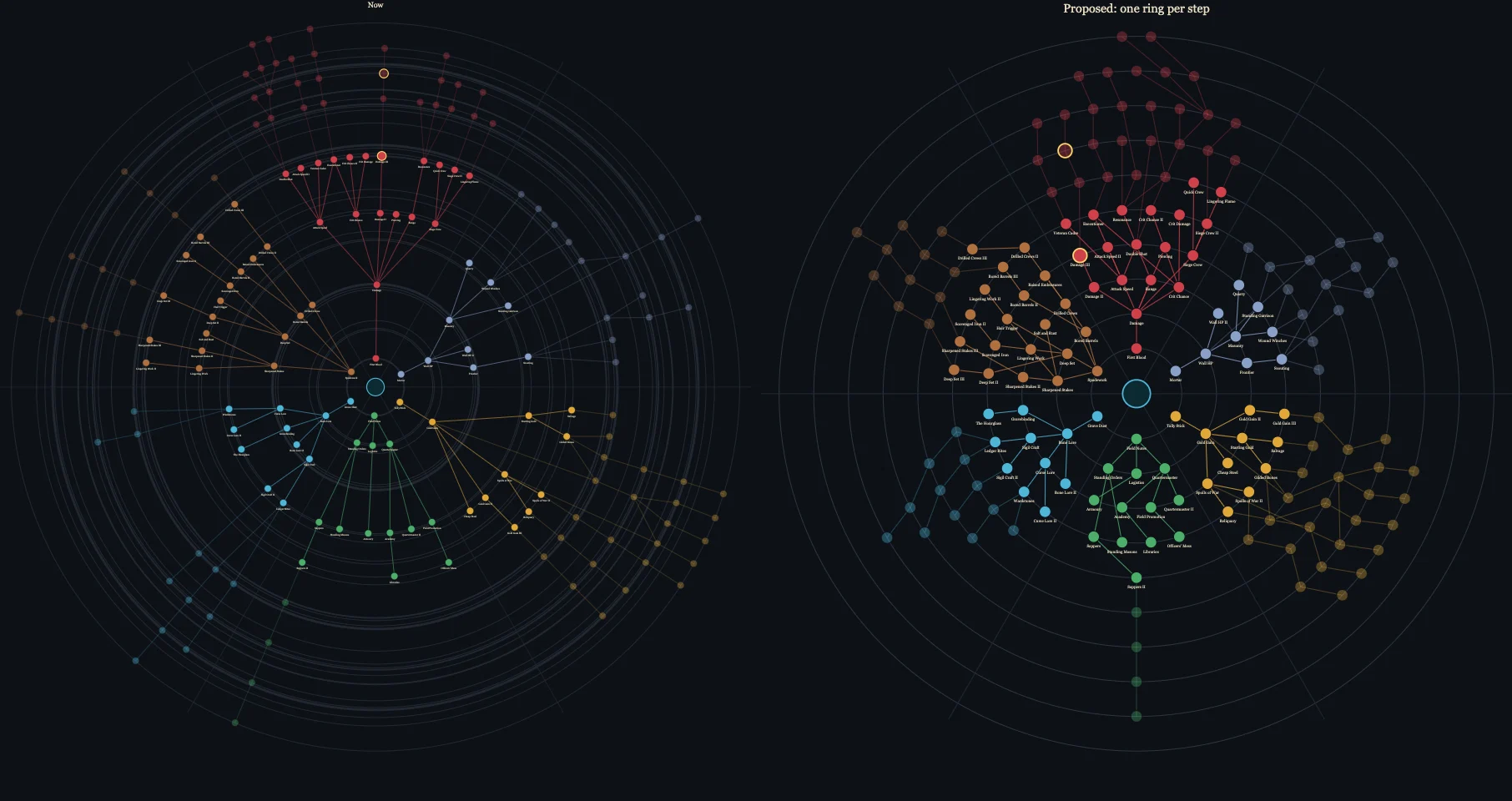
Drawing it before building it
Every change to the window was drawn first, as a plain picture of the whole tree, and argued over before any code was written. Each round of drawings turned up a problem the last one hid, and the rules came out of that:
- A ring is a step. Every medallion stands exactly on its ring, and the circles you see are those rings.
- A link runs one ring out. It never skips a ring, and no two links cross.
- A petal opens as it goes: one step on the first ring, then two, two, three, three, four.
- The steps at the edges of a ring lean on two steps inside them: buying one shows the step, buying both opens it.
- Each colour has one job: soldiers; the wall and its guns; gold and prices; training; essence and diamonds; traps.
- A medallion’s mark is the thing it improves, with a small badge for how: a coin for cheaper, a plus for more, a clock for longer.
The layout is worked out from these rules, not placed by hand. The steps are dealt out ring by ring, each petal as wide as its share of the tree, and each step hangs from the nearest step inside it. A test checks every rule on every build, so a new upgrade cannot quietly break them.
Rings to finish
With the window in order, the rings could become goals. When every step a colour has on a ring is full, that colour’s arc of the ring lights up in its own glass, and the light runs into the heart. When all six arcs are done, the whole ring lights gold.
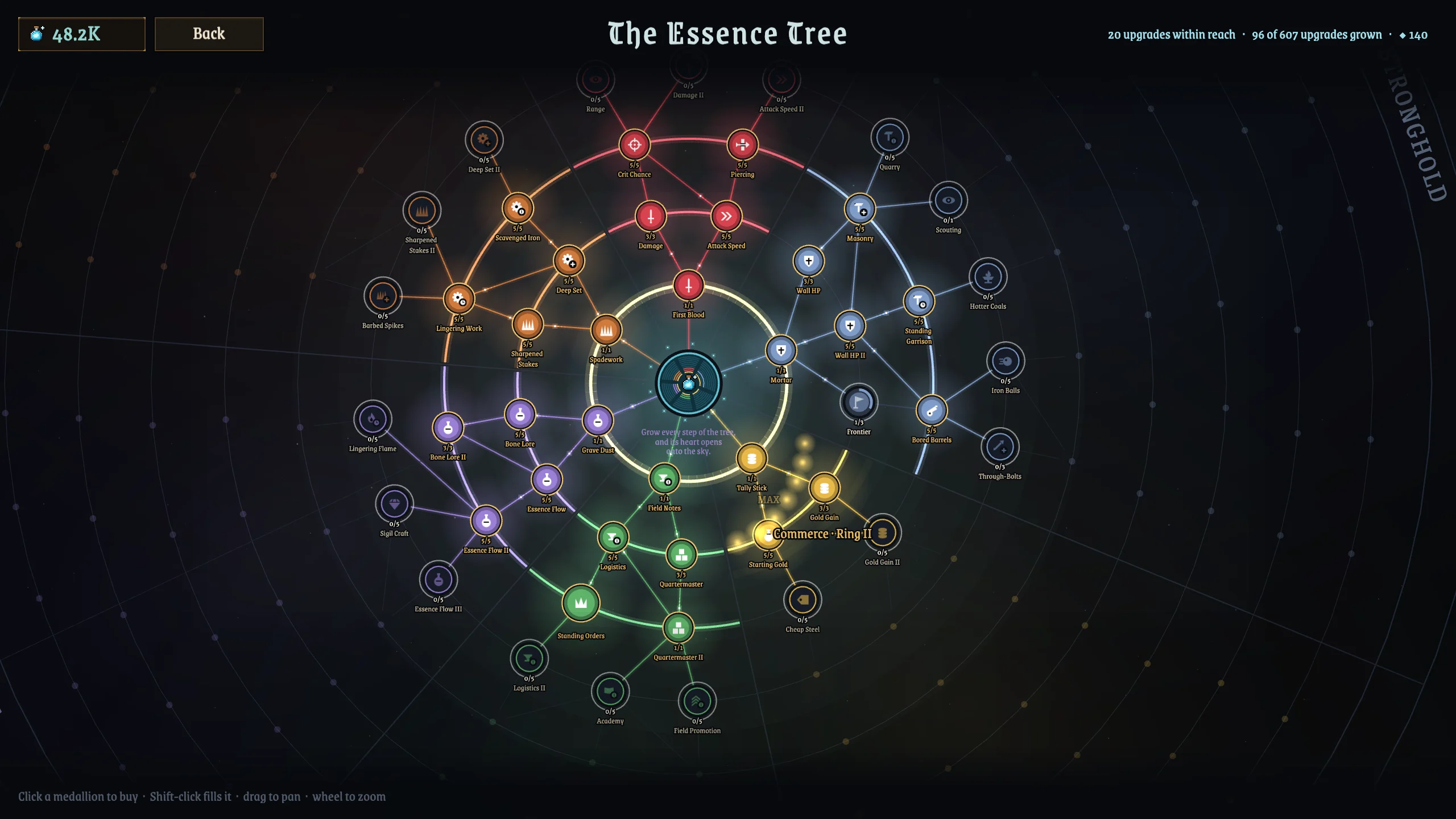
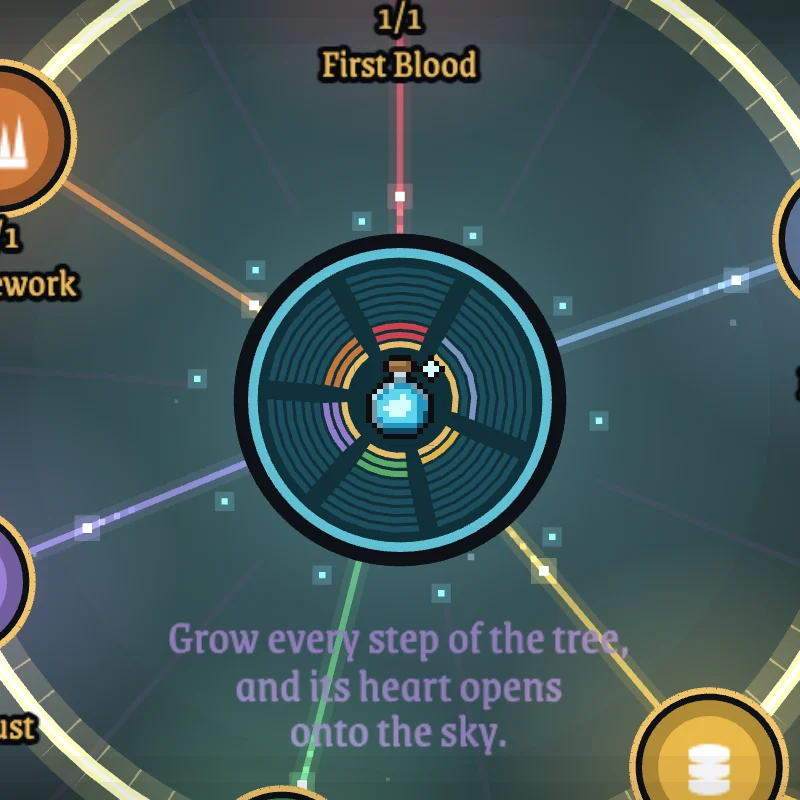
The heart is the window in miniature: one band for every ring your line has grown, cut into six panes. A finished arc fills its pane, and a finished ring turns its band gold, so a half-grown tree shows how far it has come at a glance, from the middle.
A crown on every petal
At the tip of every petal, on its axis, sits a crown: one keystone for each colour, and the step a line saves up for. Each costs as much as a good handful of the ring around it, and each changes how you play rather than adding a percentage:
- Warlord: every fifth shot of a soldier is a critical hit.
- The Wall Rallies: once a run, a falling wall rises again to half its strength.
- Strongbox: every assault you hold pays 5% interest on the gold you kept, up to half of what the assault paid. Spend it now, or keep it and let it grow.
- War College: every fifth training level of a soldier is free.
- Death’s Ledger: a fall pays its essence in full.
- Self-Setting Traps: rearming traps costs nothing.
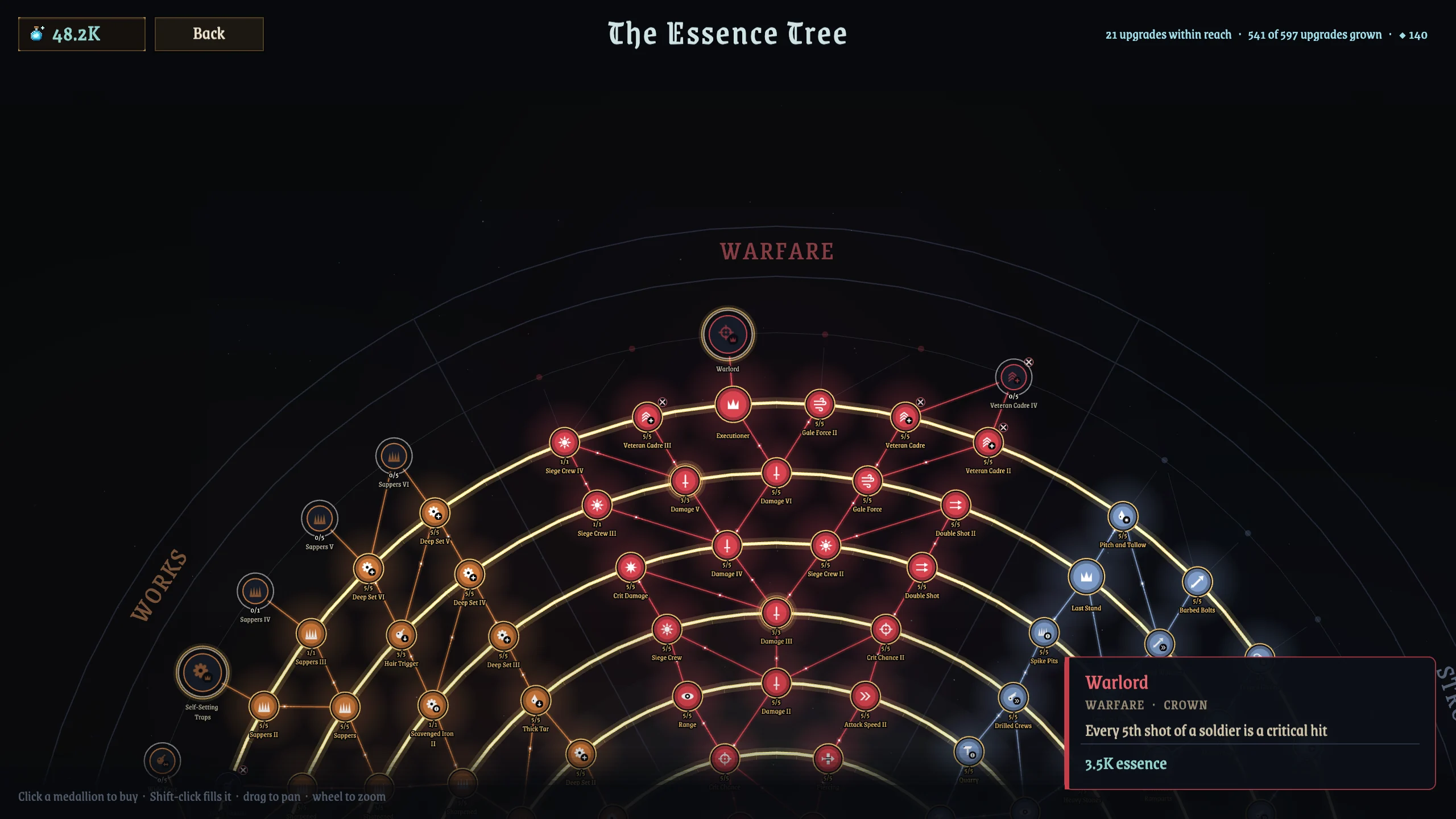
The crowns sit on the ninth ring. A first line grows five rings of the tree, and the Ancestral Sky grows the rest, so a crown is something a family works toward, not something the first night hands out.
An oath in every colour
Some steps are oaths: two rival paths, and taking one forswears the other for the rest of the line. Four colours had one, and now all six do. Arcana asks whether you want Ember Ward, longer burns and slows now, or Ledger Rites, more essence for the next line. Works asks whether to hold the dead in Iron Jaws or blow them apart with Black Powder.
Placing the oaths in the window turned up a rule the tree had been breaking: a gate on one branch must never close another. One oath step was holding up an ordinary step beyond it, so a line that swore the other way could never fill a deep tree and pass into the sky. And Essence Flow II hung from a step paid in diamonds, so a line’s essence waited on its first Colossus. Now only an oath’s own steps grow from an oath, and only diamond steps from a diamond step. The two sides of an oath take the two halves of their petal, and a test holds the rule.
Prices you can read
Last came the prices. A step now costs its ring’s price, times how much it gives: a few essence a level on the inner rings, tens on the fifth, over a hundred on the outermost. A step that gives more costs more in the same proportion, and the gifts that feed themselves (essence, gold and discounts) keep a premium of at most double. Before, a step at the tip of a long chain carried that chain’s old curve, and could ask twenty-five thousand essence beside neighbours at four hundred.
Two things were measured before it shipped. A first line’s tree asks the same essence as before, so the first pass into the sky comes at the same pace. And in the game’s own simulator, which plays real runs by the real rules, a visit to the tree after an early fall buys two to five levels instead of one. That is the shape I want: something small to buy every time, with the bright steps, the keystones and the crowns as the things worth saving for.
If a ring takes too long to finish, or a crown is not worth its price, tell me. That is exactly what Early Access is for.
— Enes